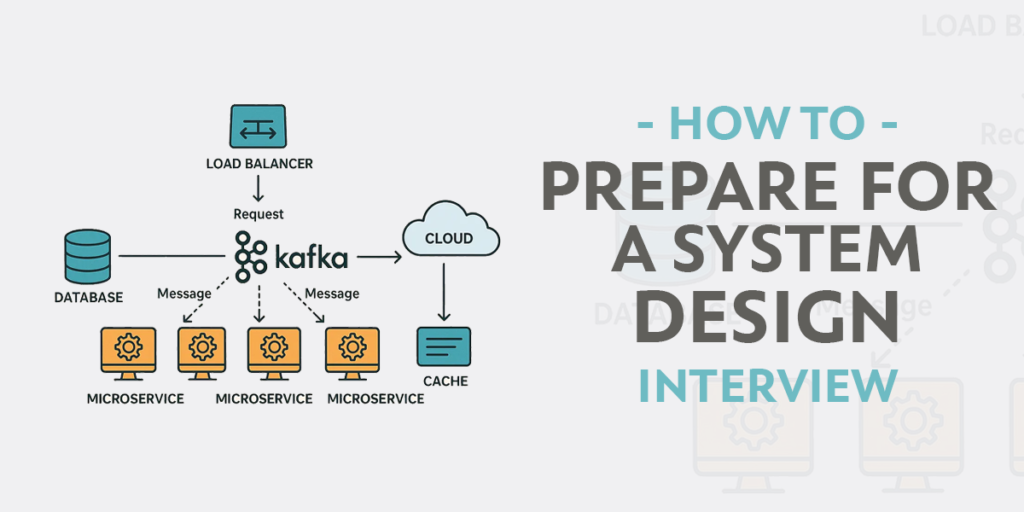
How to Prepare for a System Design Interview (Without Getting Lost in Theory)
Let’s break down something that confuses a lot of engineers: how do you actually prepare for a System Design Interview? Not in the vague, over-philosophical way most guides describe, but in a way that genuinely improves your chances of doing well.
Here’s the thing: you don’t prepare for a System Design Interview by memorizing fancy diagrams or watching someone design TikTok in 20 minutes. You prepare by building the thinking patterns that engineering managers look for.
This guide walks you through that, step by step.
Start by understanding what the interview is really grading
When you Prepare for a System Design Interview, keep in mind that the interviewer isn’t looking for the perfect architecture. They’re evaluating four practical skills:
- Your ability to unpack and clarify an ambiguous problem
- Your ability to structure a system into clean components
- Your ability to reason in trade-offs, not buzzwords
- Your ability to communicate clearly under pressure
Every part of your preparation should build at least one of these muscles.
Step 1: Master the fundamentals that actually matter
If you want to prepare for a System Design Interview well, you don’t need to study every distributed systems paper ever written. You need competence in the basics that show up in 90 percent of real systems:
- APIs and request flows
- SQL vs NoSQL
- Indexing and partitioning
- Caching strategies
- Queues, asynchronous workflows
- Load balancing and failover
- Rate limiting
- Logging, metrics, tracing
Interviewers are listening to how you navigate trade-offs:
- Strong consistency or eventual consistency?
- Fan-out on write or fan-out on read?
- Redis, Memcached, or an in-memory cache?
- Vertical scaling or horizontal scaling?
If you can’t explain your choices, you’re not ready yet.
Step 2: Practice turning vague prompts into structured problems
Most prompts are deliberately broad, and your ability to frame the problem is part of the test.
Example:
Design Instagram Stories.
Someone who knows how to prepare for a System Design Interview starts by:
- Clarifying scope
- Defining assumptions
- Identifying constraints
- Listing core components
- Choosing one or two areas to dive deeper
- Reasoning about trade-offs
- Discussing failure modes
This step alone separates strong candidates from those who’ve only memorized diagrams.
Step 3: Study real-world architectures and how they evolved
This is the difference between average prep and excellent prep.
Look at real systems and understand why they’re built that way:
- Twitter’s fan-out strategies
- Netflix’s resilience patterns
- Uber’s real-time pricing pipeline
- Kafka’s partitioning model
- Instagram’s media storage evolution
When you prepare for a System Design Interview with real case studies, you develop intuition — and intuition is exactly what interviewers hope to see.
For a deeper look at real architectures, explore Twitter’s evolution or Netflix’s Hystrix model.
Step 4: Build a repeatable approach for solving any design prompt
By interview day, your method should feel automatic.
Here’s a reliable template to prepare with:
- Clarify requirements
- Make assumptions explicit
- Define constraints (QPS, traffic patterns, storage scale)
- Draw the high-level design
- Deep dive into one critical component
- Discuss scaling, bottlenecks, and cost
- Summarize the solution cleanly
If you practice this exact structure, you’ll feel much more in control during the conversation.
Step 5: Build small systems to develop intuition
One of the best ways to prepare for a System Design Interview is by actually building things — even small versions.
Try implementing:
- a key-value store
- a rate limiter
- a feed generator
- a simple message queue
- a URL shortener
You don’t need production-grade polish. The point is to internalize how systems behave: what breaks, where bottlenecks appear, and how your decisions play out.
Hands-on experience gives you confidence no theoretical guide can match.
Step 6: Do mock interviews that push you, not ones that comfort you
A mock partner who just nods along won’t help you Prepare for a System Design Interview. You need someone who challenges you:
- Why this database?
- What happens when Redis goes down?
- How would you handle a 10x increase in writes?
- What’s your bottleneck after launch?
- How would you fail gracefully?
If you can defend your reasoning under pressure, you’re on the right track.
Step 7: Refine your communication style
A system design interview is part engineering, part storytelling. Clear thinkers do well. Rambly thinkers don’t.
Focus on:
- short, clear explanations
- early diagrams
- trade-offs instead of buzzwords
- honest limitations instead of hand-waving
A confident, structured answer wins over a loud, overly technical one every time.
Final Thought
To Prepare for a System Design Interview effectively, you need a mix of fundamentals, real architectural intuition, structured thinking, and clear communication. It’s not about memorizing patterns; it’s about showing genuine engineering judgment.
If you want, I can refine this into a fully polished blog layout with headings, SEO meta description, examples, visuals, or a more narrative voice.
Leave a Reply